

The Supreme Court of Ohio suspended Geauga County Probate-Juvenile Court Judge Timothy Grendell yesterday for 18 months, with 12 months stayed. A Supreme Court majority found that Grendell violated the Code of Judicial Conduct by impermissibly ordering two teenage boys to be held in a detention facility in an attempt to force them to engage in visitation with their father.
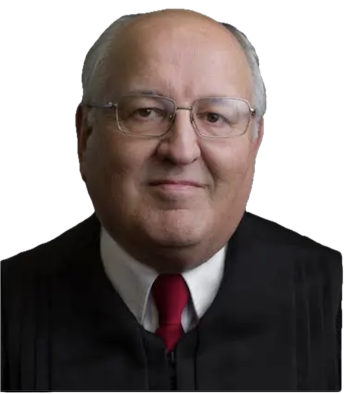
Judge Timothy Grendell
The Court rejected two other counts of charged misconduct that were based on speech protected by the First Amendment.
Judge Grendell is immediately suspended from judicial office without pay for the duration of the suspension. The Court ordered that he commit no further misconduct and stated that if he fails to comply, the one-year stay will be lifted, and he will be required to serve the full 18-month suspension.
Chief Justice Sharon L. Kennedy and Justices Joseph T. Deters, Daniel R. Hawkins, and Megan E. Shanahan joined the opinion, authored by Justice R. Patrick DeWine.
In a separate opinion, Justice Patrick F. Fischer agreed with the majority’s sanction imposed on Grendell but found he violated an additional rule by engaging in conduct that is prejudicial to the administration of justice.
Tenth District Court of Appeals Judge Carly M. Edelstein, sitting for Justice Jennifer Brunner, joined Justice Fischer’s opinion.
Legislative testimony protected by First Amendment
The Board of Professional Conduct concluded that Judge Grendell violated the rules of judicial conduct by voluntarily testifying before the legislature in connection with a 2020 bill that would have required the state government to release additional statistics on COVID-19 testing and hospitalizations.
The board concluded that his testimony violated a rule that prohibits judges from testifying before the legislature. The Court found that the rule’s prohibition on testifying before the legislature violates the First Amendment. The Court stated that “lawyers and judges do not give up their First Amendment rights to free speech just because they chose to pursue a career in law.” Applying the same test that the Court applies for any other speech restriction, the Court concluded that the rule did not pass constitutional muster.
The Court, however, noted that it was not endorsing legislative testimony by judges.
“ But whether we may discipline someone for engaging in constitutionally protected conduct is a far different question than whether such conduct is a good idea,” the opinion stated.
The Court dismissed the charges relating to Grendell’s testimony.
Political speech protected by First Amendment
The board also concluded that Judge Grendell violated rules of judicial conduct by speaking at a meeting of the Geauga County Tea Party. The Court ruled that punishing Judge Grendell for speaking to citizens about the operation of local government would violate the First Amendment.
Court Disciplines Judge Grendell for improperly detaining children
The Court found that Judge Grendell violated judicial conduct rules in handling a child-custody dispute involving two boys. Judge Grendell had ordered the boys to attend visitation with their father. When the boys resisted, Grendell charged the boys as unruly and ordered them detained for a weekend without contact with their mother.
The Court held that the record did not support charging the boys as unruly. And even if the unruly charges were warranted, there was no basis to take the boys into custody and detain them. Grendell prohibiting the boys from contacting their mother also violated a juvenile-court rule that requires detained children to be allowed to call their parents.
The Court saw the record as painting a picture of a judge “who had a strong belief that parental visitation was in the best interests of the children and who was legitimately frustrated by the failure of other means to achieve reunification between the boys and their father.” But the Court noted that Grendell’s frustration did not give him license to detain the two boys. Instead, “he willfully turned a blind eye to legal safeguards designed to protect the best interests of children and avoid unnecessary detentions.”
• • •• • •